In today’s globalized construction supply chain, buyers are no longer limited to local vendors. You can source waterproofing membranes from Asia, roofing materials from Europe, and sealants from North America—all within the same week. But this abundance of choice comes with a familiar frustration: when you receive five quotes from different suppliers, each with an email claiming “quality is good,” how do you quickly weed out unreliable options before investing time and money in a factory audit? The answer lies in certifications. However, more isn’t always better. A wall of logos on a company brochure can be misleading. Knowing what to look for—and why—matters far more than simply counting certificates.
A truly valuable certification screening process should be viewed through three distinct levels:market access, performance & safety, and environmental & sustainability, each level answering a different question about the supplier’s capabilities and the product’s fitness for your project.
Level 1: Market Access—Can This Product Enter My Country?
This is the hard threshold; without it, it’s an automatic disqualification. No matter how competitive the price or how polished the presentation, a product that cannot legally enter your market is worthless to your project. For EU construction projects, CE Marking is the absolute baseline; the post-Brexit UK market requires UKCA marking; North American plumbing and drainage systems must pass UPC or cUPC certification; and at the broader building code level, acceptance criteria such as ICC-ESR evaluation reports are essential. These are non-negotiable “must-haves”—missing even one could stall customs clearance, trigger design approval rejections, or expose your project to serious liability issues.
Take Oriental Yuhong as a practical example: our HDPE waterproofing membranes hold both CE (tested to EN 13967) and UKCA, ensuring seamless access to European and British markets. The GardMem series has successfully passed North American UPC/cUPC certification, meeting the strict plumbing codes required across the United States and Canada. Meanwhile, ICC-ESR certificates for our underlayment products GardSynFelt-100/150 and YuGuard-9IWS are both currently under active application, reflecting our commitment to full North American building code compliance. For buyers, requesting and verifying these entry-level certificates is the critical first step in determining whether a supplier can actually deliver—or is merely a trading company borrowing someone else’s paperwork.
Level 2: Performance & Safety—Will This Product Hold Up in Real Conditions?
Once market access is secured, the next and equally important question is how the product performs under actual working conditions over its designed service life. A product that is merely “legal” is not necessarily “good.” Insurance coverage for North American commercial and industrial buildings often hinges on FM Global certification, which rigorously tests fire resistance, wind uplift, and hail impact. Cool roof projects in hot climates require CRRC (Cool Roof Rating Council) reflectance and emissivity ratings to meet energy codes. Furthermore, the product standards themselves—such as EN 13967 for bitumen waterproofing, EN 13956 for plastic membranes, and EN 13707 for flexible sheets—define exactly which mechanical, thermal, and durability tests a product must pass.
Oriental Yuhong’s reinforced TPO membranes have obtained the dual FM and CRRC certification, a combination that is relatively rare in the industry. This means they not only satisfy stringent insurance underwriting requirements but also deliver proven energy-saving reflective performance that can measurably reduce a building’s cooling load. For procurement professionals, this level of certification answers the deeper question of “does it work well and last long?” rather than the superficial “can it be sold?”
Level 3: Environmental & Sustainability—Can It Help My Project Earn Green Building Credits?
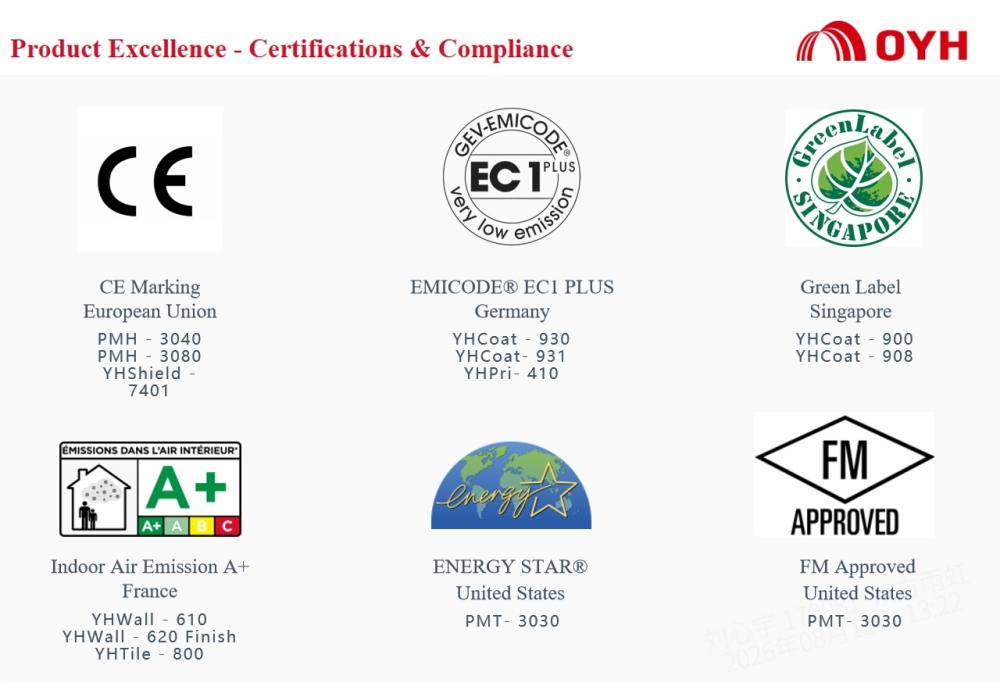
Sustainability is no longer a niche concern. An increasing number of international tenders, particularly in Europe, Singapore, and the Middle East, now write environmental certifications directly into their technical scoring criteria. EPDs (Environmental Product Declarations) provide transparent, third-party verified data quantifying a product’s full lifecycle environmental impact, from raw material extraction to end-of-life. EC1PLUS certification, governed by the German GEV institute, guarantees ultra-low VOC emissions critical for indoor air quality. Singapore’s SGBC Green Building Label and contributions to LEED certification are increasingly becoming decisive factors in winning major projects.
Oriental Yuhong’s sustainability portfolio offers a useful benchmark: PMH-3040/3040PLUS holds a comprehensive EPD published on the BRE platform, while approximately ten products under the YHPUCoat-8101 series have EPDs registered with EPD International. Additionally, YHPUcoat-8130 and over 20 VASA products have earned the stringent EC1PLUS rating, and more than 40 products across six major categories have obtained Singapore SGBC certification. If your project requires LEED points, BREEAM credits, or local green building ratings, this tier of certification becomes a genuine competitive advantage at the negotiating table.
Procurement Checklist
Before sending out a formal RFQ or placing a trial order, we strongly recommend verifying each item against the following checklist:
□ The factory holds current market access certifications for the target market (CE / UKCA / UPC, etc.)
□ The product has corresponding EN / ASTM standard test reports that match the declared specifications
□ Certification certificates are valid and current—always verify the issuing body, certificate number, and expiry date
□ The certificate holder is consistent with the manufacturing entity, confirming it is not a borrowed, rented, or expired certificate from another factory
□ EPD or verified carbon footprint data is available, which is essential for green building credits and ESG reporting
□ Comparable international project references can be provided, ideally with documented installation dates and performance feedback
How to Verify a Supplier’s Certification
1. Validate Authenticity Through Official Channels
Request the certificate number from the supplier and verify it via the issuing body’s official platform or database. Key points to confirm: whether the body is qualified to issue this type of certificate, and whether the certificate status is “active” rather than withdrawn, suspended, or expired.
2. Check Certificate Scope Consistency
• Product match: The product name, model, and specifications listed on the certificate must be completely consistent with the purchase contract. Any difference in suffix or version may mean the certificate does not apply.
• Standard version: Confirm that the technical standard referenced on the certificate is the current valid version, not an obsolete edition.
• Manufacturing address: The factory address on the certificate should match the actual supplying plant to prevent situations where “Plant A obtains the certificate, but Plant B supplies the goods.”
3. Trace the Test Report
Certificates are usually issued based on test reports. You should request the complete original test report from the supplier and verify:
• Whether the sample photos are consistent with the actual product’s appearance and structure;
• Whether the test items cover all necessary performance dimensions of the product;
• Whether the testing laboratory holds the relevant accreditations.
4. Confirm Ongoing Validity
Most certifications are not “obtain once, valid forever.” They require annual surveillance audits or periodic renewals. Ask the supplier for recent annual audit records or certificate renewal proof to avoid relying on a certificate that has already lapsed.
Is Certification Sufficient to Judge a Supplier? What Else Should Be Considered?
Certification is an entry-level requirement but far from enough to fully assess a supplier’s overall capability. The following dimensions should also be examined:
1. Implementation of the Quality Management System
A certificate only proves the system is “established,” not that it is “effectively implemented.” It is advisable to conduct an on-site factory audit or a second-party audit to observe whether incoming inspection, process control, finished product inspection, and non-conforming product handling are genuinely operational, rather than merely existing on paper.
2. Production Consistency (Sample vs. Mass Production)
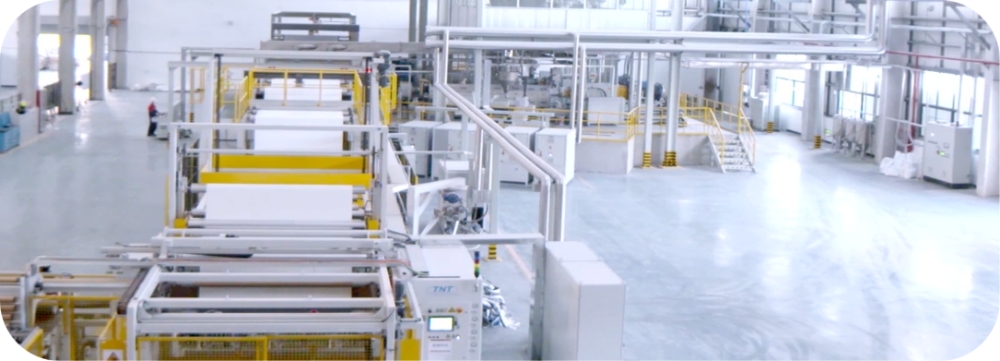
Certification is usually based on submitted samples, but mass-produced products may differ from the samples due to raw material batch variations or process parameter fluctuations. The supplier should be asked to provide factory production control records and internal quality inspection data to demonstrate their ability to maintain batch-to-batch consistency.
3. Supply Chain and Capacity Stability
• Does the supplier rely on a single source for key raw materials? Are there alternative suppliers?
• Does the certified capacity match actual order volumes? Is there a risk of quality decline due to overloaded production?
• What is the historical on-time delivery rate, and is there a sound mechanism for responding to urgent orders?

4. Technical Support and R&D Capability
• Can the supplier provide product selection guidance, detail drawings, and application or installation technical support?
• Do they have the R&D capability to adjust formulations or processes according to project needs?
• Are they willing to cooperate in completing additional tests or technical clarifications required by the project?
5. After-Sales Service and Accountability
• Are warranty terms clear (duration, scope, exclusions)?
• In the event of quality issues, what is the response speed and the mechanism for defining liability?
• Is product liability insurance in place to cover potential quality claims?
6. Sustainability and Social Responsibility
Beyond product compliance, attention should also be paid to the supplier’s performance in environmental emissions, occupational health, and carbon footprint management, which directly affects the risk of long-term cooperation.
Why OYH?
OYH is a global construction materials system service provider offering integrated solutions for commercial, industrial, infrastructure, and residential construction. Our product portfolio covers waterproofing membranes, liquid-applied coatings, tile installation systems, sealants, repair materials, and complete waterproofing and construction systems designed for long-term durability and compatibility. With over 30 years of experience in construction materials, OYH provides integrated waterproofing systems for projects in more than 150 countries and regions supported by extensive manufacturing capabilities, R&D resources and fast delivery capabilities.
Explore more about OYH waterproofing systems →
Common FAQs (5–6)
Q1: If a supplier holds a market access certificate for a certain region, does that mean the product can circulate freely in all areas of that region?
A: Certificates generally grant the right to circulate within a specific economic zone, but certain areas may have additional national-level regulations or registration requirements. It is advisable to confirm the specific regulations of the project location in advance, rather than relying solely on the supplier’s general statements.
Q2: The product model on the certificate differs only slightly from the purchased model (e.g., a suffix or color code). Can they be treated as the same certification?
A: No. Certification is “model-locked.” Any change in model, specification, formulation, or manufacturing location may invalidate the original certificate. The supplier should be asked to provide a written statement proving that the difference does not affect the validity of the certification, or to request supplementary testing.
Q3: Is certification testing based on sample submission or random sampling? How can we ensure that batch products are consistent with the submitted samples?
A: Initial certification is mostly based on submitted samples, but formal certification systems usually require annual factory audits and market surveillance sampling. It is recommended to ask the supplier for recent factory audit reports and annual surveillance records, and to stipulate incoming inspection clauses in the contract.
Q4: Grades from different test methods appear similar. Can they be used interchangeably?
A: No. Different test methods simulate different fire or usage scenarios, and their technical principles and levels of stringency are fundamentally different. Certificates cannot be substituted across methods; the test method specified by the project must be strictly matched.
Q5: Does environmental compliance testing only need to be done once to remain valid for life?
A: No. Restricted substance lists are updated periodically, and threshold determination rules may also change. It is recommended to require the supplier to sign an annual compliance declaration and establish a periodic re-testing mechanism for high-risk materials, rather than relying on a one-time historical report.
Q6: How can we determine whether a supplier is “borrowing” or “misusing” another party’s certificate?
A: Key verification points include: ① Whether the manufacturer name and address on the certificate are completely consistent with the purchase contract, invoice, and product labeling; ② Verifying the certificate holder information through the official platform; ③ Conducting an on-site factory audit to confirm whether the production site matches the certificate description; ④ Checking whether traceability marks on the product body or packaging are consistent with the certificate information.
Conclusion
Certifications are not a silver bullet, and they should never replace physical sample evaluation or on-site factory audits. But without them, there is simply no objective way to verify anything a supplier claims. In an industry where product failures can lead to catastrophic water damage, structural deterioration, and legal disputes, documentation matters. Require every shortlisted manufacturer to provide the latest valid copies of their certificates. Review certifications first, then request samples, then conduct factory audits, and finally review case studies—this is what a complete, reliable, and risk-aware supplier screening process looks like.
Choosing a manufacturer like Oriental Yuhong that has continuously invested in international certifications for nearly three decades is, at its core, about building supply chain resilience, reducing project risk, and securing long-term value for your stakeholders. If your next project requires CE/UKCA, UPC/cUPC, FM, CRRC, EPD, or EC1PLUS certified waterproofing systems, contact our team for the latest valid certificates, product samples, and technical datasheets matched to your target market’s building codes.


0 Comments