In modern industrial and commercial construction, roofing systems are no longer basic building components. They play an important role in protecting building performance, equipment safety, and operational continuity.
With the increasing scale and complexity of modern buildings—especially logistics centers, data centers, manufacturing facilities, and large-span metal roof structures—roofing systems are required to deliver higher levels of waterproofing reliability and durability.
Among single-ply roofing systems, TPO (Thermoplastic Polyolefin) membranes have become widely used due to their balanced performance and adaptability to different project conditions.
What Is TPO Roofing?
TPO roofing is a single-ply thermoplastic membrane used in low-slope commercial and industrial roofing systems. It is designed to form a continuous waterproof layer across large roof areas.
The membrane is installed using heat-welded seams, where adjacent sheets are fused together to create a durable and watertight bond. This helps reduce the risk of leakage at overlaps and improves long-term system reliability.
Due to its durability, weather resistance, and energy efficiency, TPO has become a widely adopted roofing solution for modern building envelopes.
Where Is TPO Roofing Most Commonly Used?
As TPO roofing is increasingly applied in industrial projects, it is also widely specified in facilities where roof performance is directly linked to operational safety.
In these buildings, the roof protects not only the structure, but also production processes, equipment, and stored assets.
Typical applications include:
• Data centers
• Automotive manufacturing plants
• Battery and energy storage facilities
• Electronics manufacturing plants
• Semiconductor fabrication facilities
• Pharmaceutical production buildings
• Logistics and distribution centers
• Large-scale industrial complexes
In such facilities, even minor water intrusion can result in equipment damage, production downtime, inventory loss, and substantial financial impact.
As industrial operations become more capital-intensive and technologically advanced, the tolerance for roofing failure continues to decrease. As a result, high-performance roofing systems are increasingly specified as part of a broader risk management and facility protection strategy.
Key Advantages of TPO Roofing for Industrial and Commercial Buildings
In practice, the performance of a TPO roofing system depends not only on the membrane itself, but also on formulation quality, manufacturing standards, and system design.
As a manufacturer of high-performance waterproofing systems for industrial and commercial buildings, OYH provides engineered TPO roofing solutions designed for demanding applications.
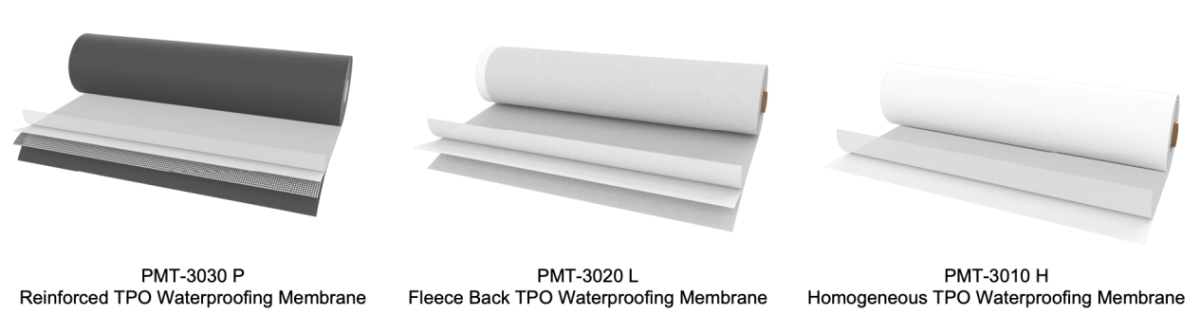
Key benefits of OYH TPO Membrane include:
Hot air welding
TPO membrane can be overlapped and hot-air welded, offers exceptionally strong seam
Long service life and long-term weatherability
Excellent durability, TPO theoretical service life can reach more than 20 years
Cool Roof = Energy-saving
High solar reflective, energy saving Environmental Friendly
Root resistance
Excellent durability and root resistance can be used as root barrier for green-roof
Corrosion preventive
Excellent chemical resistance to acids, alkali and salts
Polychrome
Available in multiple colors
Heat aging
135℃ 1344h heat aging, no cracks
Key Considerations When Selecting TPO Roofing
Selecting the appropriate TPO roofing system requires consideration of several project-specific factors, including:
• Building function and occupancy
• Climate and environmental conditions
• Roof size and geometry
• Wind uplift requirements
• Installation method
• Membrane thickness and configuration
Different TPO membrane types are available to meet different project requirements. Understanding the building’s operational needs and performance expectations is essential when choosing the most suitable roofing solution.
Key System Configurations for Different Roof Types
TPO roofing systems are selected based on roof structure and installation requirements. In general, reinforced TPO is used for metal roofs, while fleece-backed TPO is used for concrete roof systems.
Metal Roof System (Reinforced TPO)
Typical build-up (from bottom to top):
• Steel deck
• Vapor barrier
• Thermal insulation board
• Mechanically fixed reinforced TPO membrane
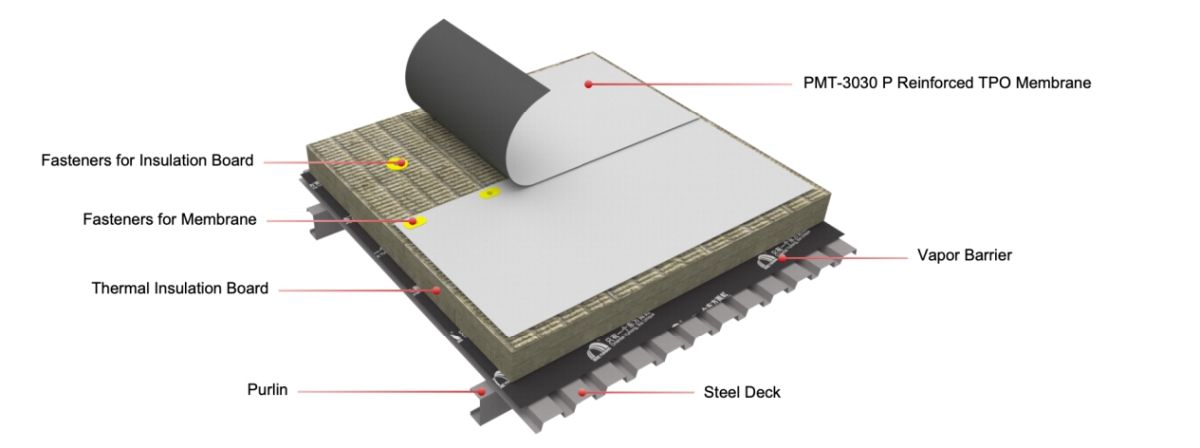
This system is commonly used for large-span metal roofs, providing wind uplift resistance and dimensional stability.
Concrete Roof System (Fleece-Backed TPO)
Typical build-up :
• Concrete roof deck
• Vapor barrier
• Thermal insulation board
• Leveling screed
• TPO specific adhesive
• PMT-3020 L Fleece-backed TPO membrane
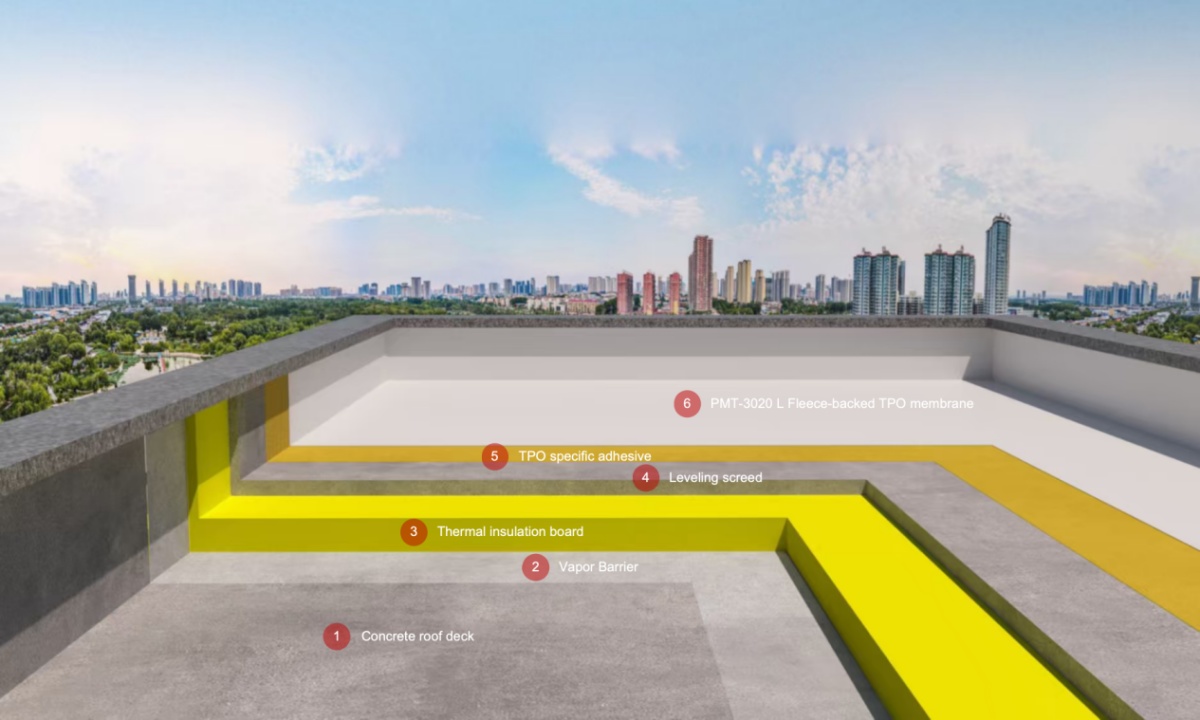
This system is suitable for concrete substrates and allows full-surface bonding for waterproofing performance.
Conclusion
TPO roofing has become a widely adopted solution for commercial and industrial buildings due to its durability, energy efficiency, and adaptability.
When properly designed and installed, TPO roofing systems provide reliable long-term waterproofing performance across a wide range of building types, including industrial facilities and large-scale commercial developments.
As a manufacturer of high-performance waterproofing systems, OYH provides engineered TPO roofing solutions designed to meet the requirements of demanding industrial and commercial applications. Our systems are developed to support long-term durability, consistent quality, and reliable field performance in different project conditions.
0 Comments